
Rice Purity Test
Created in 1984 at Rice University (Texas) for incoming freshmen. Went viral globally through college forums. Originally a fun survey to measure innocence, the Rice Purity Test is now a viral sensation! Share your score and compare with friends.
Check the items you have experienced. Your score will be calculated at the end.
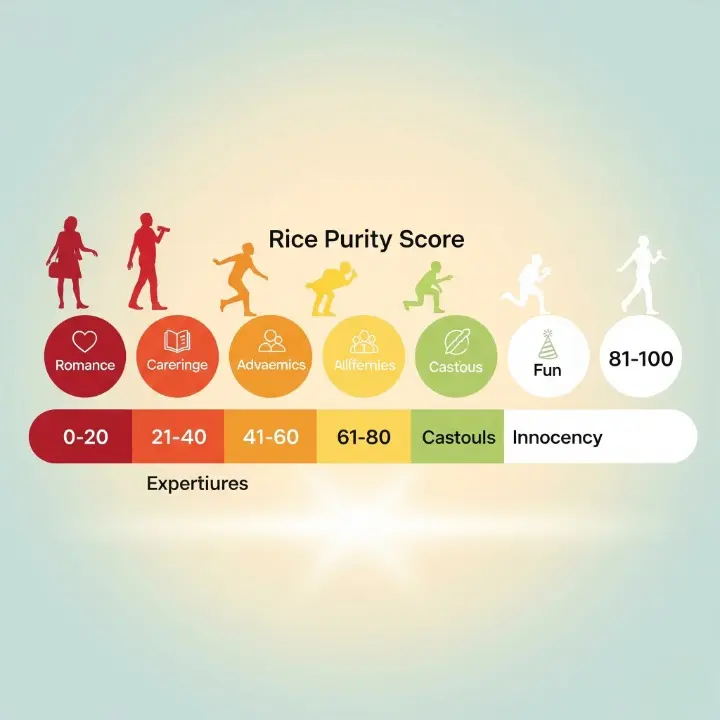
Rice Purity Test Score Meaning
| Score Range | Meaning | Personality Stereotype |
|---|---|---|
| 98-100 | Angel | “Probably lied on the test” |
| 85-97 | Very Pure | “Mom’s favorite child” |
| 70-84 | Moderately Pure | “Balanced rebel” |
| 50-69 | Average | “Typical college student” |
| 30-49 | Experienced | “Has stories you wouldn’t tell parents” |
| 0-29 | No Innocence Left | “Legend status” |
Celebrity Scores
Check your mental age test : https://mentalagetest.net/
What Is the Rice Purity Test?
The Rice Purity Test is a self-assessment survey that has become a cultural phenomenon among college students worldwide. Originally created at Rice University in Houston, Texas, this 100-question questionnaire explores various life experiences ranging from innocent activities to more mature encounters. Despite its name suggesting “purity,” the test isn’t about moral judgment – it’s simply a fun way to reflect on your personal experiences and compare them with others.
The Origins: A Rice University Tradition
The Rice Purity Test traces its roots back to Rice University, where it was initially developed as a bonding activity for incoming freshmen. The test was designed to help new students connect with their peers and navigate the social landscape of college life. What started as a local campus tradition gradually spread to other universities across the United States through word of mouth and early internet forums.
In the pre-digital era, students would pass around printed copies of the test in dormitories and during orientation activities. The questions were carefully crafted to cover a wide spectrum of experiences that typical college students might encounter, from academic challenges to social situations, romantic relationships, and personal adventures.
As the internet evolved, the Rice Purity Test found new life online, reaching far beyond Rice University’s campus. Today, millions of people worldwide have taken this test, making it one of the most recognizable self-assessment tools in popular culture.
What the Test Actually Measures
The Rice Purity Test measures life experiences, not character or morality. This is a crucial distinction that many people miss. The 100 questions cover various categories of human experience:
Experience Categories Include:
Your final score ranges from 0 to 100, where 100 represents someone with very limited life experiences (traditionally considered “pure”) and 0 represents someone who has experienced everything on the list. However, it’s important to understand that:
Why College Students Embrace the Test
The Rice Purity Test has maintained its popularity among college students for several compelling reasons:
1. Icebreaker and Social Bonding
College can be intimidating, especially for freshmen meeting new people. The test serves as a natural conversation starter, helping students find common ground and share experiences in a structured, non-threatening way. Many lasting friendships have begun with discussions about Rice Purity scores.
2. Self-Reflection and Identity Exploration
The transition to adulthood involves questioning and exploring personal identity. The test provides a framework for young adults to reflect on their experiences and consider their choices without external pressure or judgment.
3. Peer Comparison and Normalization
Students often wonder if their experiences are “normal” compared to their peers. The test offers insight into the diverse range of experiences among college students, helping individuals realize that there’s no single “correct” way to navigate young adulthood.
4. Harmless Fun and Entertainment
Taking the test with friends creates memorable moments filled with laughter, surprise, and storytelling. It’s become a beloved tradition during college orientation weeks, dorm bonding sessions, and friend group gatherings.
5. Digital Age Shareability
In our social media-driven world, the test’s numerical result makes it easily shareable. Students enjoy posting their scores, comparing with friends online, and participating in the broader cultural conversation around the test.
Your Privacy and Our Commitment to No Judgment
We want to emphasize that your privacy and comfort are our top priorities. Here’s what you should know:
Complete Privacy Protection
- No personal information required – you don’t need to provide your name, email, or any identifying details
- No data tracking – we don’t store your individual responses or connect them to your identity
- Instant, anonymous results – your score is calculated immediately and privately
- No sharing without consent – only you decide if and how to share your results
Zero Judgment Philosophy
Our platform operates on the principle that all experiences are valid. Whether your score is 15 or 95, remember:
- Every score tells a unique story of personal experience and choice
- Life experiences vary widely based on background, culture, opportunities, and personal values
- There’s no “ideal” score – what matters is that your experiences align with your personal values and decisions
- Your worth as a person is never determined by a test score
Safe Space Promise
We’ve designed this test to be a safe, judgment-free zone where you can:
- Reflect honestly on your experiences without fear of criticism
- Take the test at your own pace and comfort level
- Skip questions that make you uncomfortable
- Retake the test as many times as you’d like
- Engage with the results in whatever way feels right for you
Understanding the Cultural Impact
The Rice Purity Test has evolved into more than just a questionnaire – it’s become a cultural touchstone that reflects changing social norms and generational experiences. Students today use it as a time capsule of their college years, often retaking it to see how their experiences change over time.
The test also serves as an interesting sociological tool, revealing trends in how different generations, cultures, and communities approach various life experiences. Researchers and sociologists have noted its value in understanding youth culture and the transition to adulthood in modern society.
Ready to Discover Your Score?
Now that you understand the history, purpose, and spirit of the Rice Purity Test, you’re ready to take it yourself. Remember, this is your personal journey of self-reflection – answer honestly, stay comfortable with your choices, and most importantly, have fun with the process.
Whether you’re taking it for the first time or returning to see how your experiences have evolved, approach the test with curiosity, openness, and self-compassion. Your score is simply one small snapshot of your unique life story – and every story is worth celebrating.


What is the average score of rice purity test ?
The average Rice Purity Test score typically falls between 60-75 for most young adults (18-24 years old).
What is a rice purity test ?
The Rice Purity Test is a 100-question survey that measures your life experiences (relationships, partying, rule-breaking, etc.). Your score ranges from 0-100—higher = more “pure.” Created at Rice University, it’s now a popular way to compare experiences with friends.